Case Study 01
Stock Price Prediction Using LSTM
Bidirectional LSTM + attention, retrained daily on fresh data
The Problem
Stock price movement is notoriously hard to predict from raw historical prices alone — a lot of naive forecasting models effectively just lag the actual price by one time step and call it a prediction. The goal was to build something that goes beyond that: pulling in technical indicators and daily news sentiment as auxiliary signals, then packaging the whole thing as a pipeline that keeps itself current rather than going stale the day after training.
Approach
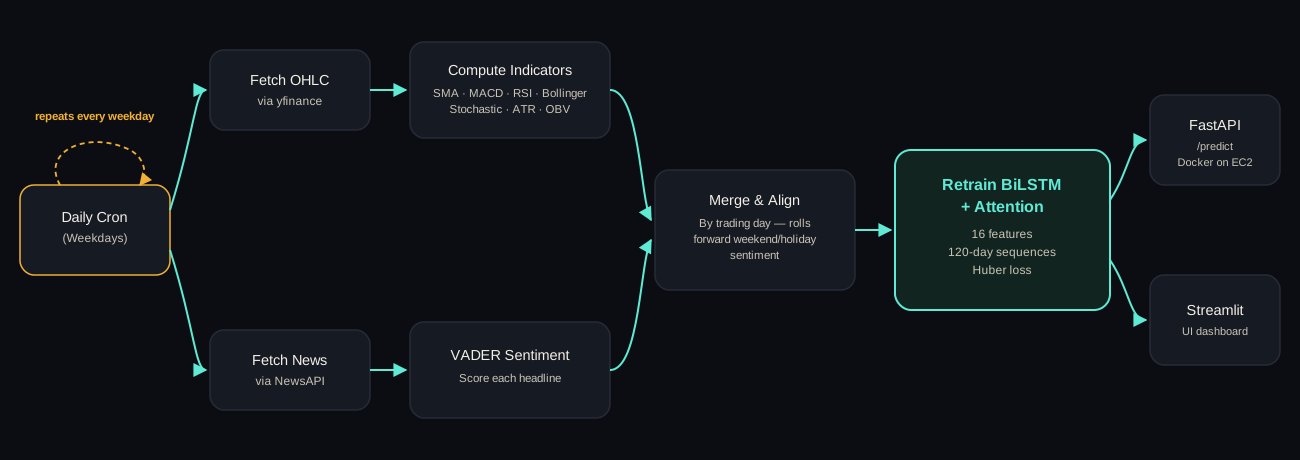
- 01Ran a daily cron job (weekdays) that pulled fresh OHLC data via yfinance and computed a full technical-indicator set — SMA, MACD, RSI, Bollinger Bands, Stochastic Oscillator, ATR, and OBV.
- 02In parallel, pulled the day's news headlines via NewsAPI and scored each one with VADER sentiment analysis.
- 03Merged the two streams by trading day, rolling weekend and holiday sentiment forward onto the next trading day so no signal was silently dropped.
- 04Retrained a Bidirectional LSTM with an attention mechanism on 16 features across 120-day sequences, using Huber loss for robustness to price outliers.
- 05Served predictions two ways: a FastAPI /predict endpoint (containerized with Docker, deployed on AWS EC2) for programmatic access, and a Streamlit dashboard for interactive use.
Visuals
Results
15% improvement in prediction accuracy over baseline models.
MAE of 1.73 and RMSE of 2.91 on held-out test data.
Fully automated daily refresh — new data, new sentiment, and a retrained model with zero manual steps.
Reflection
The architecture ended up mattering as much as the data — moving from a plain LSTM to a bidirectional model with attention, and handling the weekend/holiday sentiment gap explicitly, both came from hitting real edge cases while building this rather than being obvious upfront. If I revisited this, I'd backtest the model against an actual trading strategy rather than point-accuracy metrics alone, since a lower MAE doesn't always translate into profitable decisions.