Case Study 02
Real-Time Face Detection, Gender & Emotion Classification
Two parallel CNNs with Grad-CAM interpretability
The Problem
Reading emotional state or gender from a face is something humans do intuitively but is genuinely hard for a model — human accuracy on 7-class emotion classification is only about 65% ± 5%, and CNN architectures accurate enough for the task are usually too heavy for real-time, hardware-constrained use. The goal was a general framework for building lighter real-time CNNs, validated by a live system that does face detection, gender classification, and emotion classification simultaneously — and to actually look inside the models rather than treat them as black boxes.
Approach
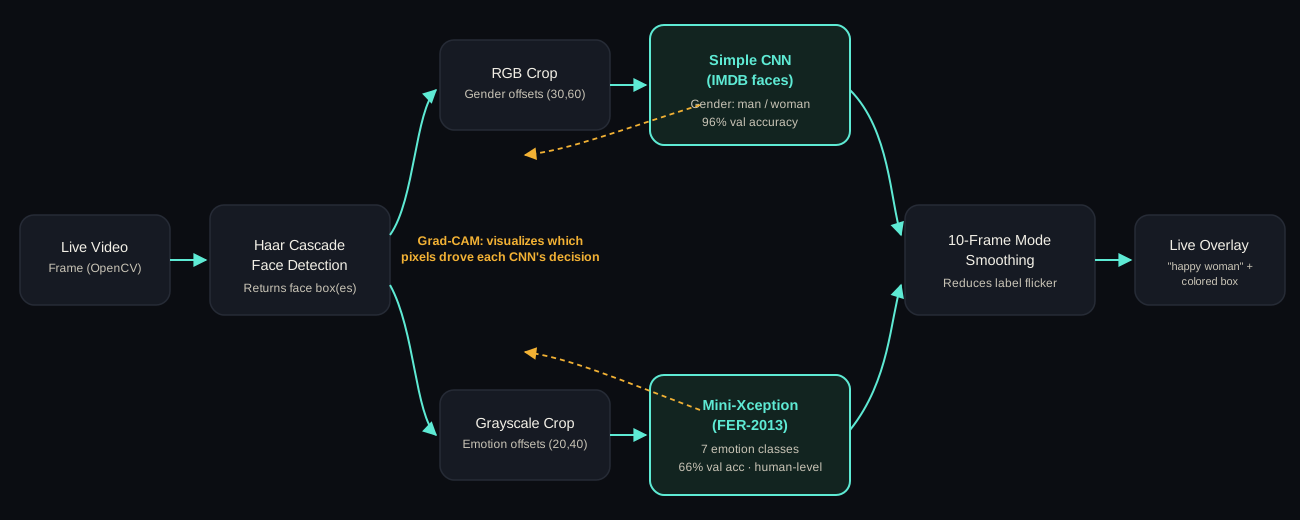
- 01Used Haar Cascade classifiers for face detection on each incoming video frame, then extracted two differently-padded crops per face — one RGB crop for gender, one grayscale crop for emotion.
- 02Compared two lightweight CNN designs: a fully-convolutional network with Global Average Pooling (no fully-connected layers), and a mini-Xception architecture using depth-wise separable convolutions with residual modules — mini-Xception won out for the deployed emotion model.
- 03Trained the gender classifier on the IMDB faces dataset and the emotion classifier on FER-2013 (7 classes: angry, disgust, fear, happy, sad, surprise, neutral), each independently.
- 04Applied a 10-frame sliding-window mode filter to both predictions to stop labels from flickering frame-to-frame on live video.
- 05Implemented guided Grad-CAM visualization to see which pixels each CNN actually used to make its decision, turning both models from black boxes into something inspectable.
Visuals
Results
96% validation accuracy on gender classification (simple CNN, IMDB faces).
66% validation accuracy on 7-class emotion classification — in line with the ~65% human baseline for the same task.
Grad-CAM analysis surfaced a real bias: the gender classifier skewed toward western facial features and accessories, and glasses measurably interfered with emotion classification.
Reflection
The most valuable part of this project wasn't the accuracy numbers — it was using Grad-CAM to find that the gender model was biased toward certain facial features and accessories. It's one thing to know CNNs can be biased in theory; it's another to actually visualize your own model doing it. If I revisited this, I'd want to rebalance the training data to specifically address that bias rather than just document it.