Case Study 05
Food Context Classification via Transfer Learning
ResNet-50 · home vs. restaurant vs. packaged food
The Problem
Most food-image classifiers try to identify what the food is. This project asked a different question: can a model reliably classify the context a food photo was taken in — at home, in a restaurant, or as packaged goods — using scene cues rather than the dish itself?
Approach
- 01Fine-tuned a pretrained ResNet-50 on a food-context dataset labeled by scene (home, restaurant, packaged) rather than by dish.
- 02Ran four separate training strategies — baseline transfer learning, standard data augmentation, injected synthetic noise, and a combined approach — to isolate which techniques actually helped.
- 03Evaluated all four strategies on a held-out test set using consistent metrics for a fair, controlled comparison.
Visuals
Results
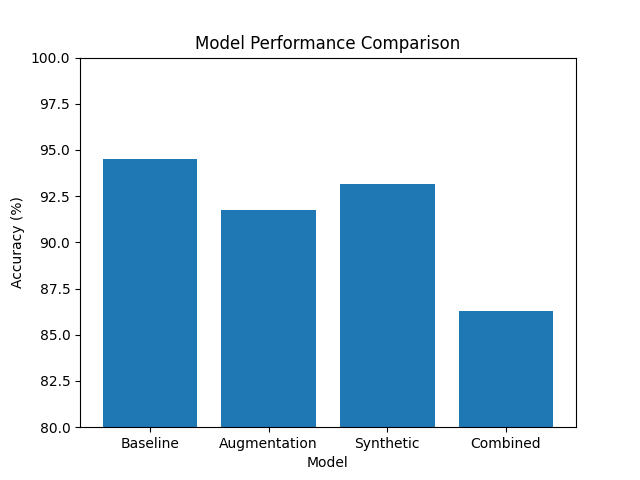
94.5% test accuracy with the plain baseline transfer-learning model — the best of the four.
Synthetic noise came closest at 93.1%; augmentation alone dropped to 91.7%; combining both hurt most, falling to 86.3%.
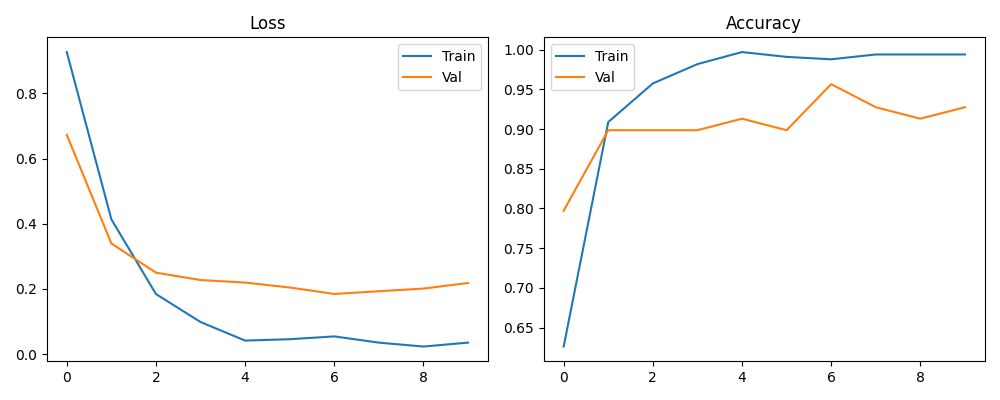
Training curves show validation accuracy plateauing while training accuracy kept climbing — a sign of mild overfitting the augmentation strategies didn't fix.
Reflection
The most useful finding was a negative one: none of the augmentation strategies beat the plain baseline, and stacking them made things worse, not better. It's a good reminder that more complexity in a training pipeline isn't automatically better — augmentation choices need to be validated against your specific dataset, not assumed to help.